
How to Load an Enclosed Cargo Trailer: Balance & Tie-Downs
An enclosed cargo trailer protects your load from weather and theft, which makes it the go-to for moving, motorcycles, tools, and gear. But four walls can hide a badly balanced load until you feel the sway on the...
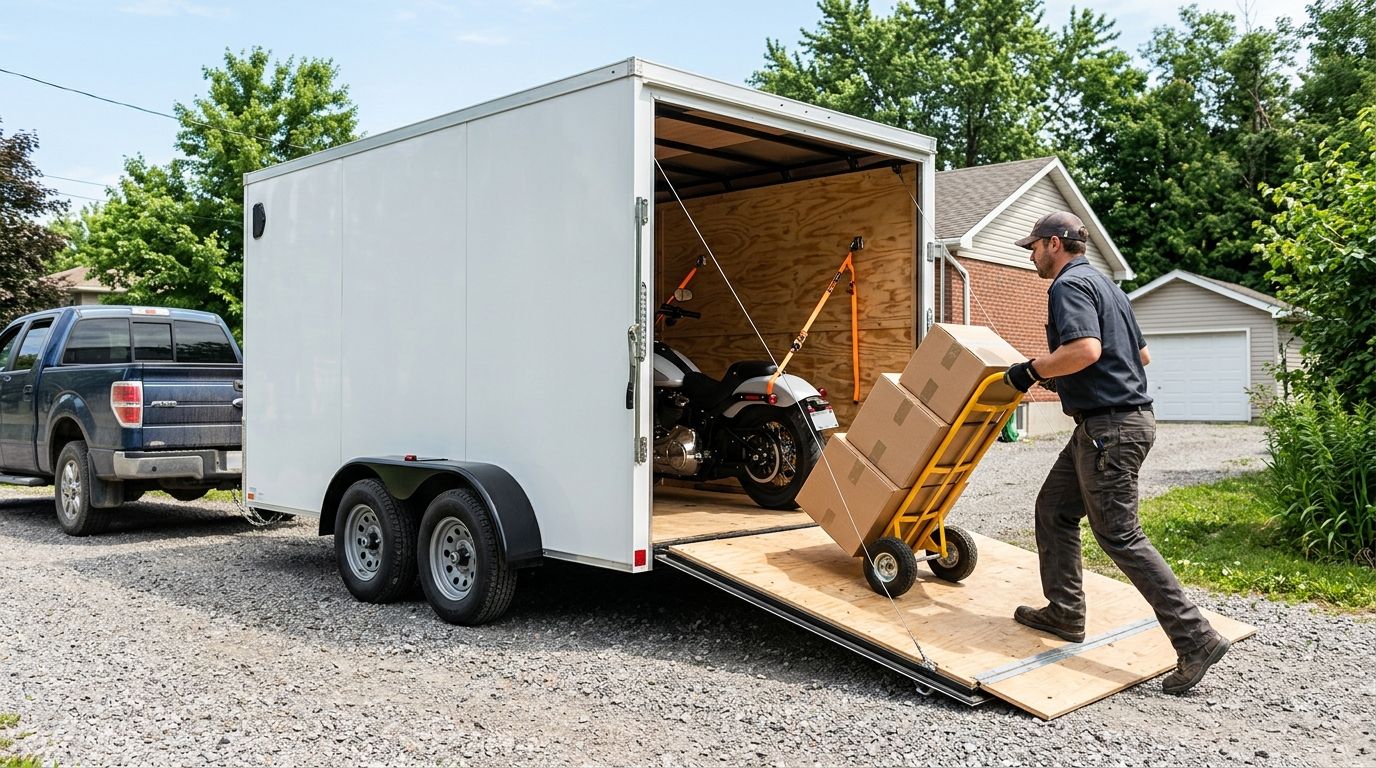
To load an enclosed cargo trailer safely, place about 60 percent of the weight toward the front, ahead of the axles, for proper tongue weight. Load the heaviest items first against the front wall, roll cargo up the rear ramp door, anchor everything to the D-rings or E-track so it cannot shift, keep the load balanced side to side, and stay under the trailer GVWR and your tow rating.
An enclosed cargo trailer protects your load from weather and theft, which makes it the go-to for moving, motorcycles, tools, and gear. But four walls can hide a badly balanced load until you feel the sway on the highway. The rules are the same as any trailer, plus a few tricks unique to a box you pack from the inside. Here is how to load an enclosed cargo trailer so it tows straight and arrives intact.
Load Front-Heavy for Tongue Weight
Even though you cannot see the load once the doors are shut, weight distribution still rules. Put about 60 percent of the cargo weight ahead of the axles and 40 percent behind for roughly 10 to 15 percent tongue weight. Start by placing your heaviest items against the front wall, then pack lighter items behind them.
- Heaviest at the nose: appliances, tool chests, and machines go against the front wall.
- Build backward: stack and pack lighter cargo toward the rear as you fill.
- Balance side to side: split heavy items across the centerline so one wheel is not overloaded.
Using the Ramp Door and Packing Tight
Most enclosed trailers have a rear ramp door. Lower it fully, roll cargo straight up the middle, and pack the load tight so nothing has room to slide during transit. Gaps are where damage happens.
- Lower the ramp fully. Let it sit flat on solid ground before rolling anything up.
- Roll heavy items in first. Use a hand truck and take the heaviest pieces to the front wall.
- Pack tight and layer. Fill gaps with soft goods so nothing can shift, and do not stack heavy on fragile.
- Close and latch. Confirm the ramp door is fully latched before you pull out.
Anchoring to D-Rings and E-Track
The advantage of an enclosed trailer is built-in anchor points. Most have floor D-rings or wall-mounted E-track. Use them. Straps run to solid anchors keep motorcycles, furniture, and stacks from tipping when you brake or corner.
- Motorcycles and equipment: four-point tie-down to floor D-rings, straps rated above the item weight.
- Tall or stacked cargo: strap across to E-track so stacks cannot topple forward under braking.
- Fragile items: secure against a wall and pad the contact points.
- Re-check early: stop after the first few miles and re-tension every strap.
Want the checklist on paper? Download our free printable enclosed cargo trailer load sheet and tuck it inside the trailer.
Know Your Weight Limits
Enclosed trailers weigh more empty than an open trailer of the same size, which eats into your payload. Check the GVWR on the plate, subtract the empty weight for your real capacity, and confirm your tow vehicle is rated for the loaded trailer. It is easy to fill a big box past its rating without realizing it.
When you need one, you can find an enclosed cargo trailer to rent near you on BigLoads. New to towing? Read our guide to loading a trailer safely first, or compare options in the enclosed trailer rental guide.
Common Enclosed Trailer Loading Mistakes
Skip the errors that ruin loads inside a box:
- Loading heavy toward the rear, which removes tongue weight and causes sway.
- Leaving gaps so cargo slides and gets damaged in transit.
- Skipping the built-in D-rings and E-track and hoping the walls hold everything.
- Overloading because you cannot see how full it really is.
- Stacking heavy items on top of fragile ones.
Related on BigLoads: tie-downs & ratchet straps in The Workshop.
Frequently Asked Questions
How do you load an enclosed cargo trailer for towing?
How do you keep cargo from shifting in an enclosed trailer?
Where do you put the heaviest items in an enclosed trailer?
How do you tie down a motorcycle in an enclosed trailer?
How much can an enclosed cargo trailer carry?
Ready to haul?
Find the right trailer near you — or list yours and start earning.